Designing a Comprehensive Order Form Logbook KDP Interior for Streamlined Business Operations
Managing orders effectively is one of the most critical yet often overlooked aspects of running a small business, freelancing operation, or creative enterprise. Without a reliable system to track sales, customer details, inventory movements, and income flows, even the most promising ventures can descend into chaos. For entrepreneurs, educators, hobbyists, and professional creators alike, the Order Form Logbook KDP Interior has emerged as a practical and versatile solution that bridges the gap between analog record-keeping and digital convenience. This resource, when paired with a well-designed Custom Order Form Template, a robust Purchase Order Form Template, and an editable Order Form Editable system, becomes the backbone of orderly transaction management.
The beauty of a properly constructed logbook interior lies in its adaptability. Whether you are a solopreneur selling handmade crafts on Etsy, a small retail shop owner tracking wholesale purchases, or a service provider documenting client orders, the combination of a Printable Craft Order Form and a dedicated Order Form For Small Business framework ensures that every detail is captured with precision. This article explores how the 120-page interior design—complete with high-resolution JPG, PNG, and PDF files at 300 dpi—transforms a simple notebook into a powerful operational tool. We will examine its key characteristics, practical applications, workflow integration, and the subtle considerations that make it a standout choice for KDP publishers and end users alike.
Anatomy of a Purpose-Built Order Form Logbook Interior
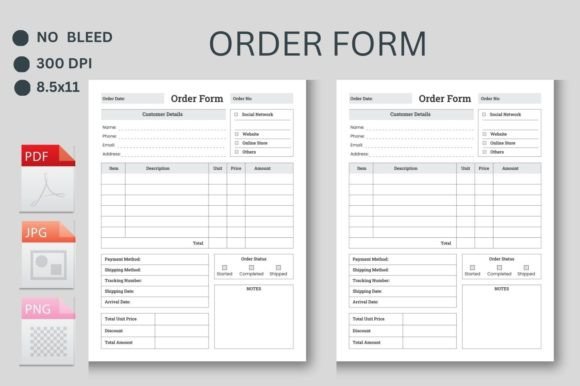
A well-crafted Order Form Logbook KDP Interior is not merely a collection of blank pages. It is a thoughtfully structured instrument that guides the user through every stage of order processing. The standard 8.5″ × 11″ size, with no bleed and print-ready formatting, makes it ideal for both home printing and professional reproduction. The inclusion of 120 pages provides ample space for recording hundreds of transactions without becoming unwieldy. Each page is designed with a clear layout that balances information density with visual clarity, allowing users to note customer details, order descriptions, quantities, pricing, payment status, and delivery timelines in a single glance.
The interior files—available as JPG, PNG, and PDF at 300 dpi—offer flexibility for different use cases. The PDF version is perfect for direct printing or uploading to platforms like Amazon KDP, where it has been tested and verified for seamless compatibility. The image formats allow for easy digital manipulation, enabling users to insert the pages into note-taking apps, digital planners, or even customize them further using graphic design software. This multi-format approach ensures that the Order Form Editable capability extends beyond simple text entry, accommodating diverse workflows from paper-based tracking to hybrid digital-analog systems.
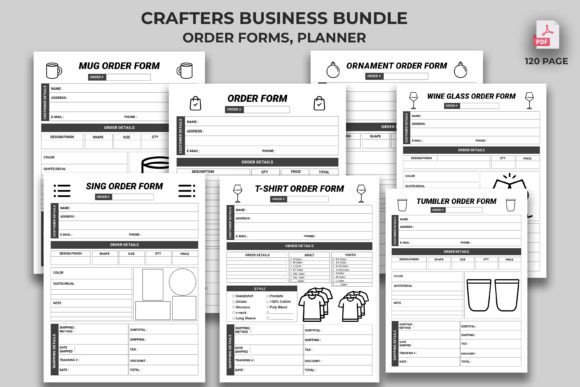
Key design elements include clearly demarcated fields for order numbers, dates, customer contact information, item descriptions, unit prices, subtotals, taxes, and total amounts. Additional sections for notes, shipping details, and payment methods transform each page into a comprehensive transaction record. The consistent header and footer structure also supports easy scanning and reference, making it an excellent record keeping book for audit trails and historical analysis.
Integrating Purchase Order Forms and Custom Order Templates into a Unified Workflow
One of the most powerful features of this interior design is its seamless integration of different form types. While the core Order Form Logbook KDP Interior focuses on customer-facing sales orders, many businesses also require a dedicated Purchase Order Form Template to manage their own procurement from suppliers. By combining these two elements within the same logbook system, users gain end-to-end visibility into their supply chain. The purchase order section captures vendor details, item codes, expected delivery dates, and cost prices, creating a direct link between outgoing orders and incoming inventory.
Similarly, the Custom Order Form Template allows for personalization that reflects the unique needs of different industries. A photographer booking sessions might include fields for shoot location, duration, and usage rights. A craftsperson selling custom furniture could add dimensions, material choices, and finishing preferences. The Printable Craft Order Form variant is particularly popular among artisans who sell at markets, pop-up shops, or through social media. Its compact yet comprehensive layout fits easily onto a clipboard or desk, capturing everything from product variations to deposit amounts. When these templates are compiled into a single logbook, the user benefits from a unified system that eliminates the need to juggle multiple notebooks or digital platforms.
For small business owners, the Order Form For Small Business component is a lifeline. It consolidates customer orders, purchase orders, and inventory tracking into one portable volume. The logbook becomes a central hub where income and expense data converge, supporting better financial decisions and simpler tax preparation. The ability to flip through pages and quickly locate an order from weeks or months ago enhances customer service and dispute resolution. This integrated approach turns the logbook from a passive recording tool into an active management asset.
Practical Use Cases Across Different Professional Contexts
The versatility of the Order Form Logbook KDP Interior is best understood through the lens of real-world applications. Consider a small batch cosmetic maker who sells online and at local markets. Each customer order requires careful notation of product combinations, scent preferences, and customization requests. Using a Custom Order Form Template within the logbook, the maker can record these details systematically, reducing the risk of errors and ensuring consistent product delivery. The Purchase Order Form Template section helps track raw material orders from suppliers, linking ingredient costs to final product pricing.
In the educational sector, teachers and school administrators use order forms for book fairs, fundraising events, and field trip permissions. The Printable Craft Order Form is especially handy for art teachers who manage supplies for multiple classes. The logbook serves as both an ordering tool and a record of who received what, simplifying inventory management and budget tracking. Researchers and hobbyists who organize group purchases—such as seed orders for community gardens or component orders for electronics projects—find the Order Form Editable feature invaluable for collecting and consolidating requests from multiple participants.
Event planners, wedding coordinators, and catering services rely on the logbook to manage orders from clients and vendors simultaneously. The interior's clear column structure accommodates complex orders with multiple line items, dietary restrictions, and delivery timelines. The Order Form For Small Business layout naturally supports the fast-paced environment of event logistics, where accuracy and speed are paramount. Even freelance professionals like graphic designers or web developers can use the logbook to document project briefs, milestone payments, and revision requests, transforming a general-purpose order logbook into a client management system.
Advantages of the 120-Page Interior Design for KDP Publishers and End Users
From a publishing perspective, the Order Form Logbook KDP Interior offers several distinct advantages. The 120-page count hits a sweet spot between perceived value and production cost—thick enough to feel substantial yet economical to print. The 8.5″ × 11″ trim size is a standard KDP format that minimizes setup complexity and maximizes compatibility with Amazon's printing infrastructure. The inclusion of JPG, PNG, and PDF files with 300 dpi resolution ensures crisp output across different printers and digital platforms. The no-bleed specification simplifies the upload process, as there are no trim marks or extended backgrounds to manage. For publishers who want to expand their low-content book catalog, this interior provides a ready-to-upload solution that has been tested and verified on Amazon KDP, reducing the risk of formatting errors or rejection.
For end users, the advantages are equally compelling. The high-resolution print quality ensures that small text remains legible and that checkboxes, lines, and tables are sharply defined. The 120 pages offer months to years of usage depending on order volume, making it a cost-effective alternative to purchasing multiple smaller notebooks or pads. The ability to download the files in multiple formats gives users freedom—they can print a single page as needed, import the PDF into a note-taking app for digital annotation, or use the PNG files to create custom stickers or inserts for a ring binder. The Order Form Editable nature of the design, when combined with software like Adobe Acrobat or Canva, allows users to add their own branding, logo, or specific field labels.
Another significant benefit is the logbook's role as an expense log book and income tracker in one. By recording both sales and associated costs, users can monitor profitability at a glance. The consistent structure supports periodic reviews—weekly, monthly, or quarterly—enabling trend analysis and informed decision-making. This dual functionality reduces the number of separate tools required, streamlining the administrative side of running a business or managing a project.
Considerations for Selecting and Customizing the Right Template
While the Order Form Logbook KDP Interior provides a robust foundation, there are a few considerations that can help users optimize it for their specific needs. First, think about the volume and complexity of orders you typically handle. If your transactions are simple and repetitive, a minimalist Purchase Order Form Template with fewer fields may be more efficient. Conversely, if you deal with highly customizable products or services, a Custom Order Form Template with additional space for notes, attachments, or sketches will be more useful. Many interiors include blank or partially blank pages specifically for this purpose, allowing for free-form documentation without disrupting the structured order forms.
Printing quality also matters. The files are designed for 300 dpi and print-ready formatting, but the final result depends on your printer and paper choice. For everyday use, 20 lb to 24 lb paper works well. For a more professional feel, consider 28 lb or heavier paper. If you plan to use the logbook in a binder or as a spiral-bound notebook, factor in margin adjustments or ensure the interior includes appropriate spacing. The no-bleed design is forgiving in this regard, as there is no critical content near the edges.
For KDP publishers, keyword optimization is essential to reach the right audience. Terms like order logbook, sales, order, customer, income, inventory, livestock, interior, small, expense log book, journal notebook, order book, order forms, order log book, order planner, order tracker, order tracking book, record keeping book, kdp interior, diary, kdp publishing, low content, custom kdp interior, unique, manuscript, journal, notebook, planner, tracker, record, keeper, logbook, log book, book, reminder, checklist, organizer, daily, form, information, layout, note, page, paperwork, schedule, authority, buttons, chart, cyberspace, date should be naturally woven into the product description and backend keywords. The interior itself, with its clear layout and structured fields, embodies many of these concepts, making it easier for customers to find exactly what they need.
Workflow Integration and Digital-Physical Hybrid Use
One of the most forward-thinking aspects of modern order management is the hybrid workflow—combining the tactile reliability of paper with the searchability and accessibility of digital tools. The Order Form Logbook KDP Interior is ideally suited for this approach. Users can print the PDF pages and keep a physical binder for daily recording, then periodically scan or photograph completed pages to digitize the data. The high contrast and clear layout of the 300 dpi interior ensure that optical character recognition (OCR) software can accurately extract text from scanned images, enabling digital search and analysis.
Alternatively, the PNG files can be imported into apps like GoodNotes, Notability, or OneNote, where users can write directly on the pages using a stylus. This preserves the familiar structure while adding the benefits of digital storage, cloud backup, and instant retrieval. The Order Form Editable quality of the interior means that even in digital form, the tables and fields remain usable and scalable. For businesses that use inventory management software, data from the logbook can be manually entered or partially automated through scanning, serving as a reliable offline backup in case of system outages.
The integration of a Purchase Order Form Template and Printable Craft Order Form into the same logbook also supports a unified view of the order lifecycle. A craft business owner, for instance, can start with a purchase order to a fabric supplier, then create a customer order using a custom form, and finally reconcile both in the same logbook. This eliminates the disconnect that often occurs when using separate systems for purchasing and sales, fostering a holistic understanding of business health.
Long-Term Value and Scalability for Growing Operations
As a business or creative practice grows, the need for structured record-keeping becomes more acute. The Order Form Logbook KDP Interior scales naturally with the user. Early-stage entrepreneurs might use a single logbook that covers all aspects of operations—customer orders, purchase orders, expense tracking, and income recording. As volume increases, they can graduate to multiple logbooks organized by function or by month, maintaining the same familiar layout. The consistent design across all interior files ensures that switching between physical and digital formats or between different logbooks does not introduce confusion.
The sheer number of order logbook and record keeping book features built into the interior reduces the learning curve for new users. Employees, contractors, or family members who assist with order processing can quickly understand and adopt the system because the fields are intuitive and logically arranged. This standardization is particularly valuable for businesses that rely on seasonal help or multiple part-time staff. The logbook becomes a shared reference point that maintains data integrity even when different people are responsible for entering information.
Moreover, the logbook serves as a historical archive that supports trend analysis, tax audits, and business valuations. Because each page captures complete transaction details—customer name, date, items, prices, payment status—a full logbook provides a rich dataset for understanding sales patterns, seasonal fluctuations, and customer preferences. For businesses that plan to seek financing or sell their operation, a well-maintained order logbook demonstrates professionalism and financial discipline. The physical nature of the logbook also adds a layer of permanence that purely digital records can lack, safeguarding against data loss due to hard drive failures, software deprecation, or cloud service discontinuation.
Practical Enhancement Ideas for the Order Form Logbook Experience
Users who want to get the most out of their Order Form Logbook KDP Interior can consider a few enhancements. Adding color-coded tabs or divider pages for different sections—such as customer orders, purchase orders, and expense tracking—improves navigation within the logbook. Using a consistent color for checkmarks or stickers on completed orders provides a quick visual status update. Laminated cover sheets or reinforced binder holes extend the physical durability of printed pages.
For those who use the digital PNG or JPG files, creating a custom template in Canva or Photoshop that includes a business logo and color scheme can elevate professional branding. The editable nature of the interior supports this kind of customization without requiring a complete redesign. Some users may also choose to print the forms on different colored paper for easy categorization—for example, white for customer orders, yellow for purchase orders, and pink for backorders or pending items.
Additionally, pairing the logbook with a simple checklist or reminder system—such as a weekly review of outstanding orders or a monthly reconciliation with bank statements—maximizes the utility of the recorded data. The structured fields in the Order Form Editable interior make these reviews straightforward, as all necessary information is presented in a consistent format. Over time, this practice builds a reliable operational rhythm that reduces errors and improves customer satisfaction.
The Role of the Logbook in a Digital-First World
In an era dominated by digital dashboards and cloud-based inventory systems, the Order Form Logbook KDP Interior holds a unique and relevant position. Not every business has the budget or technical inclination to adopt sophisticated ERP software. Many solo operators, artists, and small retailers prefer the simplicity and tangibility of a paper logbook. It requires no batteries, no internet connection, and no subscription fees. It can be used at a market stall, on a workshop bench, or during a client meeting without technical barriers.
Furthermore, the act of physically writing down order details has been shown to improve memory and attention to detail. For creative professionals who value the tactile experience of their work, the logbook aligns with their overall ethos. The Printable Craft Order Form is a natural extension of the handmade, personalized nature of their products. The logbook itself becomes a part of the creative toolkit, as essential as a sketchbook or a set of tools.
At the same time, the availability of digital formats ensures that no one is forced to choose between analog and digital—they can have both. This hybrid capability is the hallmark of a well-designed modern resource. The Order Form Logbook KDP Interior is not a relic of a pre-digital age; it is a thoughtfully engineered tool that meets the needs of contemporary users who value flexibility, reliability, and control over their data.
From the perspective of KDP publishing, this interior represents a low-content product with high potential. It appeals to a broad audience—business owners, educators, hobbyists, event planners, and service providers—all of whom require organized order management. The tested compatibility with Amazon's printing process reduces risk for publishers, while the versatile file formats broaden the product's appeal. As e-commerce and small business activity continue to grow, the demand for practical, well-designed order management tools will remain strong. The Order Form Logbook KDP Interior, with its comprehensive features and user-centric design, is well-positioned to meet that demand.