Social Worker Session Notes Notebook
Every session you hold with a client holds meaning—small insights, subtle shifts in tone, a breakthrough after weeks of silence. Capturing those moments accurately is what separates good notes from documentation that actually supports healing. A Social Worker Session Notes Notebook is simply a dedicated place to record everything that matters during and after each appointment. Instead of juggling loose papers, random digital notes, or generic planners, this notebook gives you a structured system that matches the way social workers actually think and work.
The core idea is straightforward: you have a consistent format for logging client concerns, therapeutic approaches, session plans, and progress over time. No more wondering where you wrote down that crucial detail from three weeks ago. Everything lives in one place, organized in a way that makes sense for your workflow. Whether you are a recent graduate building your first caseload or an experienced clinician managing dozens of clients, having that structure saves mental energy and reduces the risk of missing something important.
What makes this notebook different from a regular notepad
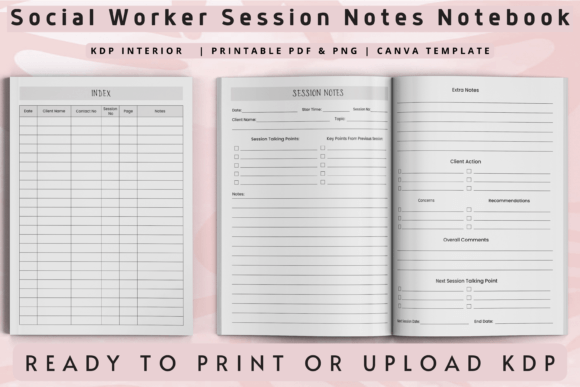
A blank notebook forces you to invent your own system, which works fine until you have six clients in a day and your handwriting gets messy. This Social Worker Session Notes Notebook comes with a framework already built in. The layout encourages you to note the client’s presenting problems, the therapeutic approach you used, the plan going forward, and any observable progress markers. It does not tell you what to write—it simply makes sure you do not forget the key pieces that professional standards and ethical practice require.
The format also supports continuity. When you flip back through previous entries, you can see patterns emerging: Is this client’s anxiety consistently worse on certain days? Did that intervention from last month actually lead to measurable change? These insights are hard to spot when your notes are scattered across different systems. With a dedicated notebook, the history of the therapeutic relationship lives in chronological order, ready to inform your next session.
Another practical advantage is that the notebook is designed for real-world use. The pages are 8.5 x 11 inches with no bleed, meaning you can write comfortably without ink seeping through to the other side. For social workers who prefer pen and paper over screens, this feels natural and reduces friction. And because it is a physical object, you do not have to worry about battery life, software updates, or privacy breaches from cloud storage—though of course you still need to store the notebook securely.
Who benefits most from a structured session notebook
Many social workers start their careers using whatever is available—a spiral notebook, a digital document, or the forms provided by their agency. But as your caseload grows, you realize that good notes are not just about compliance. They are about being able to recall nuanced details during supervision, justify your clinical decisions in a report, or simply feel prepared when a client walks into the room. The notebook helps with all of that.
For freelancers and private practitioners, this kind of tool is especially valuable. When you work independently, you are responsible for everything: scheduling, billing, clinical notes, and self-care. A notebook that streamlines documentation frees up mental bandwidth for the actual therapy work. For agency-based social workers, it can serve as a personal working document—something you use during the session to jot down key points, then later transfer to the official electronic health record. Having a draft in your own words before you formalize it into agency language is surprisingly helpful.
Students and interns also find this useful. Learning to write clear, organized session notes is a skill that takes practice. A notebook with guided prompts helps you develop that habit early. Instead of wondering what to include, you follow the structure until it becomes second nature. By the time you graduate to full licensure, the process feels automatic.
Practical ways to use the notebook in daily work
There is no single right way to use a session notes notebook, but here are a few realistic approaches that experienced social workers have shared:
- Before each session, review the previous entry. This takes two minutes but dramatically improves the quality of your opening questions. You can reference something the client mentioned last time, showing them you remember and care.
- During the session, keep the notebook open but use it lightly. Jot down key phrases, emotional shifts, or specific statements you want to revisit. Do not try to capture everything—that interrupts the flow. Just enough to jog your memory later.
- Immediately after the session, expand your notes while the details are fresh. Note the client’s presenting problem, the intervention you used, their response, and your plan for next time. This is where the structured format really helps because it prompts you to cover each area without overthinking.
- Weekly or monthly, flip through recent entries to identify progress or lack thereof. If a client has been stuck on the same issue for six weeks with no movement, that is important clinical information. The notebook makes these patterns visible.
One social worker described using the notebook to track subtle progress that did not show up on standardized assessments. A client with severe social anxiety started making eye contact for a few seconds in session four. That detail felt small, but noting it allowed the worker to celebrate that progress with the client later, reinforcing the therapeutic alliance. These are the kinds of observations that generic note-taking systems miss.
What you get inside the package
This Social Worker Session Notes Notebook is delivered in multiple formats so you can use it in whatever way fits your workflow. The package includes a PNG file for quick reference or digital preview, a PDF file ready for printing, a PowerPoint file for those who prefer to type their notes digitally or customize the layout further, and a Canva Editable File Link that lets you modify colors, fonts, and fields without needing special software. There is also a ready-to-upload PDF in 8.5 x 11 inches with no bleed, totaling 120 pages. That gives you enough space for months of sessions, depending on your caseload.
The variety of formats matters because not everyone works the same way. Some people want to print a stack of pages and bind them themselves. Others prefer to keep everything on a tablet and type directly into a PowerPoint or Canva template. Having the Canva link is especially helpful if you want to add your logo, change the headings, or adjust the spacing to match your style. The notebook is customizable in a way that a mass-produced planner never is.
For social workers who travel between multiple sites, having a digital version means you can access your notes from your phone, laptop, or tablet without carrying a heavy binder. For those who value handwriting for memory retention, the printable PDF gives you a clean, professional page to write on. You can choose what works for you on any given day.
Things to think about before choosing a session notes notebook
While a structured notebook is a powerful tool, it is not a magic solution. The quality of your notes still depends on your clinical judgment and attention to detail. The notebook provides the container, but you fill it with meaningful content. If you are someone who prefers completely free-form journaling, the prompts might feel restrictive at first. That is okay—you can adapt them over time or use the editable version to adjust the fields.
Privacy is another consideration. Physical notebooks must be stored securely, especially if they contain identifying information about clients. If you work in a shared office or take notes in public spaces, consider using codes or initials instead of full names. Digital files should be password-protected and stored on encrypted devices. The notebook format itself does not replace your ethical and legal obligations around confidentiality.
Also think about how this notebook fits with your agency’s documentation requirements. Some organizations have strict formats for clinical notes, and this notebook may serve as a personal working document rather than the official record. That is fine—many social workers keep a personal notebook for their own reference and then transfer the official notes into the required system. The notebook helps you capture the human details that agency forms often leave out.
Finally, consider your note-taking style. If you prefer typing over handwriting, the digital formats give you that flexibility. If you love the tactile experience of pen on paper, the printable PDF is ideal. The important thing is that the tool matches your habits, not the other way around. A notebook that feels natural to use will actually get used.
Session notes are more than paperwork—they are the written record of your professional presence in someone’s life. A Social Worker Session Notes Notebook helps you honor that responsibility with clarity, consistency, and care. Whether you are just starting out or looking to refine an existing practice, having a dedicated space for your clinical observations makes the work more manageable and more meaningful. The structure is there to support you, not constrain you. And in a field where every detail matters, that kind of support is worth having.