The Essential Guide to the Refrigerant Tracking Log Book for Compliance and Efficiency
In an era where environmental accountability and operational precision are no longer optional but mandatory, industries that rely on refrigeration and air conditioning face a unique set of challenges. The management of refrigerants has moved from a back-office administrative task to a front-line operational priority. At the heart of this shift lies a simple yet powerful tool: the Refrigerant Tracking Log Book. This is not merely a ledger for recording numbers; it is a strategic instrument that ensures compliance, reduces environmental impact, and streamlines maintenance workflows. Professionals in HVAC, automotive service, commercial refrigeration, and facility management are increasingly recognizing that a structured logbook is the foundation of responsible refrigerant stewardship.
Understanding the Refrigerant Tracking Log Book
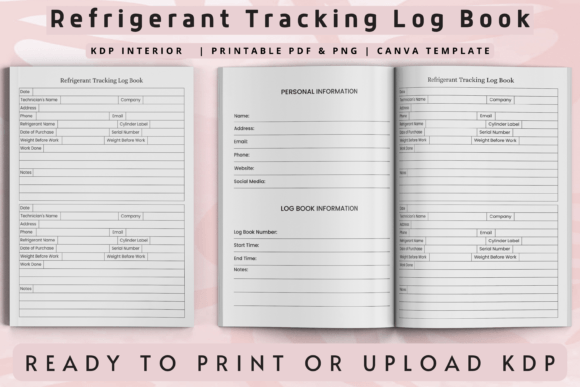
A Refrigerant Tracking Log Book is a dedicated record-keeping system designed to document every interaction with refrigerants within a system or facility. It captures critical data points such as the type and amount of refrigerant added or removed, the date of service, the technician responsible, leak test results, and any repairs performed. This logbook is specifically designed to help you keep track of each maintenance operation and meet the Section 609 MACS requirements, which govern the servicing of motor vehicle air conditioning systems under the Clean Air Act. The logbook transforms sporadic notes into a coherent, auditable history that satisfies regulatory scrutiny and informs better decision-making.
The product offering described includes a PowerPoint file, PNG file, PDF file, and a Canva Editable template, all pre-formatted at 8.5 x 11 inches with 120 pages, no bleed, and ready for upload. This template is ready for you to go to Amazon and submit, especially if you have a low-content or no-content book business. It is fully tested and ready to list on Amazon's KDP platform, making it an accessible solution for professionals who need a reliable tracking system without starting from scratch.
The Regulatory and Environmental Imperative
The demand for meticulous refrigerant tracking is driven by a convergence of regulatory pressure and environmental necessity. Governments worldwide are tightening policies on hydrofluorocarbons (HFCs) and other ozone-depleting substances. The Section 609 of the Clean Air Act, enforced by the EPA, mandates that anyone servicing motor vehicle air conditioning systems must use certified refrigerant recycling equipment and maintain proper records. The Refrigerant Tracking Log Book directly addresses these requirements by providing a structured format for documenting all service activities, thus helping technicians and businesses avoid penalties and demonstrate due diligence.
Beyond compliance, the environmental argument is compelling. Refrigerants are potent greenhouse gases, and even small leaks contribute significantly to global warming. By maintaining an accurate log, organizations can identify patterns of leakage, schedule timely repairs, and minimize refrigerant loss. This proactive approach aligns with broader sustainability goals and corporate social responsibility initiatives. For businesses that report their carbon footprint, the logbook provides verifiable data that supports emissions reporting and reduction strategies.
Why the Market Is Paying Attention
Several factors explain the growing interest in the Refrigerant Tracking Log Book. First, the phase-down of HFCs under the Kigali Amendment to the Montreal Protocol is prompting companies to manage their refrigerant inventory more carefully. As the supply of certain refrigerants becomes constrained, the cost of leakage rises, making conservation economically advantageous. Second, the rise of predictive maintenance in facility management emphasizes data-driven decision-making. A logbook supplies the historical data necessary to forecast equipment failures and optimize servicing schedules.
Third, the gig economy and the proliferation of independent service technicians create a need for portable, standardized record-keeping tools. Freelancers and small business owners in HVAC and automotive repair often lack the infrastructure of large corporations. A pre-designed logbook template that can be uploaded to KDP and printed on demand offers these professionals an affordable and professional solution. They can maintain credible records without investing in expensive software or custom printing.
Finally, consumers and clients are becoming more informed about environmental issues. A service provider who can present a well-maintained refrigerant log demonstrates competence and responsibility, which builds trust and differentiates them in a competitive market.
Changing Workflows and Operational Needs
The traditional approach to refrigerant tracking often involved scraps of paper, digital notes on a phone, or memory alone. These methods are unreliable and fail under audit. The modern Refrigerant Tracking Log Book addresses changing needs by offering a structured yet flexible format. The 120-page template allows for extensive coverage across multiple systems or a full year of service operations. Its no-bleed design ensures clean printing without trimming, and the 8.5 x 11-inch size is standard for binders and filing systems.
For workflow integration, the logbook functions as a physical companion to digital tools. Technicians can fill it in the field and later digitize the data if needed. This hybrid approach accommodates different comfort levels with technology while ensuring that no information is lost. The inclusion of both PDF and editable Canva formats means that users can customize fields to match their specific equipment, refrigerant types, or reporting requirements. This adaptability is crucial for businesses that handle multiple types of systems, from residential heat pumps to commercial chillers.
Moreover, the logbook supports changing expectations around transparency and accountability. Facility managers now demand proof of maintenance from contractors. A completed logbook provides that evidence and can be included in handover documentation when equipment is sold or decommissioned. It also serves as a training tool for new technicians, showing them what data is important and how to record it correctly.
Practical Examples in Action
Consider a mid-sized automotive repair shop that services 30 vehicles per week. Without a tracking system, the shop might lose track of how much refrigerant it purchases versus how much it uses, leading to inventory discrepancies or accidental overuse. With a Refrigerant Tracking Log Book, the shop assigns a page to each vehicle or each system. Every service entry includes the refrigerant type (e.g., R-134a, R-1234yf), the amount recovered and recharged, leak test results, and technician initials. Over time, the shop notices that a particular model of car requires frequent recharges. This pattern prompts an investigation that reveals a common seal failure, allowing the shop to offer a preventive repair service that saves customers money and reduces refrigerant emissions.
Another example involves a commercial refrigeration company managing twenty supermarket installations. Each store has multiple refrigeration units with different refrigerants. The company uses a logbook per site, with sections for each unit. During an EPA audit, the company can produce the logbooks and demonstrate compliance with record-keeping requirements in minutes. The auditors see that every refrigerant transaction is documented, from delivery to disposal. This efficiency not only avoids fines but also streamlines the audit process, reducing downtime and stress for staff.
For the independent HVAC freelancer, the logbook is a professional asset. When bidding for a contract with a property management firm, the freelancer can show that they maintain meticulous records. This evidence of systematic practice becomes a competitive advantage, helping them win contracts that require high standards of accountability.
Connecting to Larger Industry Developments
The emergence of the Refrigerant Tracking Log Book is part of a broader movement toward operational transparency and environmental stewardship. The Internet of Things (IoT) and smart sensors are transforming how we monitor equipment, but these technologies require baseline data to calibrate alerts and analytics. A physical logbook provides that baseline in a tangible, verifiable form. As artificial intelligence and machine learning begin to predict refrigerant leaks based on usage patterns, the historical records from a logbook will be invaluable for training models and validating predictions.
Additionally, the push for circular economy principles in the HVAC industry means that refrigerants must be recovered, reclaimed, or destroyed at end of life. A logbook is essential for tracking this lifecycle, proving that refrigerants were handled responsibly. This documentation supports compliance with regulations like the EPA's venting prohibition and the requirements for technician certification.
The rise of remote work and digital nomads has also increased the demand for print-on-demand products like this logbook. Entrepreneurs and content creators on platforms like Amazon KDP are looking for niche products that solve real problems. The Refrigerant Tracking Log Book fits perfectly into this trend because it addresses a specific, ongoing need in a regulated industry. It is a low-content product that provides high value through careful design and adherence to standards. The inclusion of PowerPoint, PNG, PDF, and Canva Editable files means that buyers can use it immediately or customize it for their brand, making it a versatile offering in a growing market.
Meeting Professional Standards with Confidence
For professionals who take their work seriously, a standardized logbook is more than a convenience; it is a mark of professionalism. It signals to clients, regulators, and peers that you operate with integrity and precision. The Refrigerant Tracking Log Book designed with Section 609 MACS requirements in mind gives you a framework that is already aligned with regulatory expectations. You do not need to interpret guidelines or guess what information to record. The template guides you through the necessary data points, reducing the risk of omissions that could lead to non-compliance.
Moreover, the 120-page capacity ensures longevity. Whether you service one system or a hundred, you have room to grow. The no-bleed format and standard page size mean that printing is straightforward, whether you use a home printer or a professional service. The ready-to-upload PDF eliminates formatting headaches, allowing you to focus on content and compliance rather than layout.
The Strategic Value of a Logbook in Your Operation
Viewing the Refrigerant Tracking Log Book solely as a compliance tool underestimates its strategic value. The data it contains can inform purchasing decisions, identify training needs, and highlight equipment that is underperforming. For example, if a particular system requires frequent refrigerant top-ups, the logbook reveals this trend, prompting a leak investigation that could prevent a major failure. The cost of a logbook is negligible compared to the savings from avoiding a compressor burnout or a refrigerant loss incident.
In larger organizations, the logbook facilitates knowledge transfer. When a technician leaves or retires, their undocumented knowledge often leaves with them. A completed logbook captures that expertise in a form that new hires can understand and build upon. It also supports continuous improvement initiatives by providing data that can be analyzed to refine maintenance protocols.
For entrepreneurs who create and sell this logbook on Amazon KDP, the product taps into a stable demand. The HVAC and automotive service industries are not going away, and regulations are only becoming more stringent. By offering a product that is pre-tested, compliance-ready, and customizable, you provide a solution that professionals need and will continue to need for the foreseeable future.
Conclusion
The Refrigerant Tracking Log Book is far more than a collection of blank pages. It is a system for accountability, a tool for efficiency, and a record of environmental responsibility. In an industry where the cost of non-compliance and the consequences of leakage are high, a structured logbook is an essential investment. Whether you are a solo technician, a shop owner, or a facility manager, adopting a logbook that meets Section 609 MACS requirements positions you for success. The availability of a ready-to-upload template on Amazon KDP makes it easier than ever to implement this practice. By embracing this tool, you not only protect your business but also contribute to a more sustainable and transparent industry. The future of refrigerant management is data-driven, and it starts with a simple, well-kept log.