Weekly Budget Planner: A Practical Guide to Financial Organization
A Weekly Budget Planner is a structured document or tool designed to help individuals track income, expenses, and savings on a week-by-week basis. Unlike monthly budgeting systems, this format focuses on shorter intervals, making it easier to catch overspending early and adjust behavior in real time. The version referenced here includes 120 interior pages, available in JPG, PNG, and PDF formats at 300 dpi, sized at 8.5″ × 11″ with no bleed—specifications that are ready for print and suitable for platforms like Amazon KDP. But beyond its technical specifications, the real question is whether this type of planner aligns with your financial habits and goals.
Understanding the Weekly Budget Planner Format
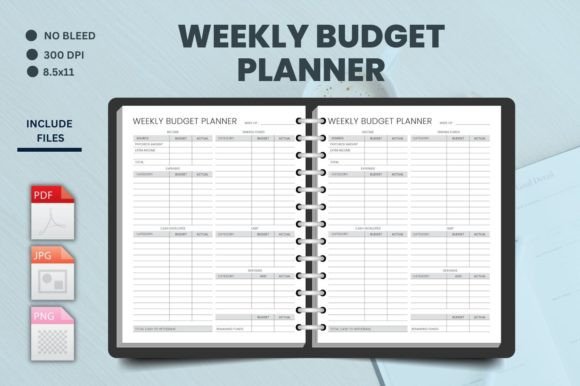
At its core, a Weekly Budget Planner is a paper or printable template that organizes your finances around a seven-day cycle. The design typically includes sections for income, fixed expenses, variable spending, savings goals, and a running balance. Many versions also incorporate tracker elements for expense tracking, checklist items for bills, and note areas for reflections. The illustration and layout often emphasize clarity, using horizontal lines, geometry-based grids, and blank spaces for customization. This format is particularly appealing for those who prefer a tangible, non-digital approach to financial management.
The 120-page interior means you have roughly two years of weekly pages if you use one page per week, or you can combine multiple pages for more detailed tracking. The high-resolution vector-based files ensure clean printing, and the no-bleed specification simplifies trimming if you decide to bind it yourself. These details matter if you are considering self-publishing through KDP or simply want a reliable printable that looks professional.
Why People Consider a Weekly Budget Planner
Several motivations drive interest in a Weekly Budget Planner:
- Granular control: Weekly tracking catches small leaks in spending before they become monthly problems.
- Behavioral awareness: Frequent check-ins build a habit of mindful spending.
- Flexibility: You can adjust mid-month without waiting for a monthly review.
- Visual organization: A dedicated journal or notebook keeps all financial data in one place.
- Goal alignment: Goal-oriented sections help you tie daily choices to larger financial objectives.
For people who find monthly budgets too broad or who struggle with impulse spending, a weekly format provides a tighter feedback loop. It also works well for those with irregular income, such as freelancers or gig workers, because you can plan around actual cash flow rather than averages.
What the Files Include: Features and Specifications
The Weekly Budget Planner package comes as a template with three file formats: one JPG, one PNG, and one PDF. All are at 300 dpi, ensuring sharp graphic quality when printed. The size is standard US Letter (8.5″ × 11″) with no bleed, which means the content fits within the printable area without needing to be trimmed. The interior consists of 120 pages, and the files are print-ready—tested on Amazon KDP to confirm compatibility. The design is clean, with a focus on planning over decoration, making it suitable for both personal and business use.
Key features include:
- 120 pages of weekly spread sheets
- High-resolution (300 dpi) for professional print quality
- No bleed, so no content is cut off during printing
- Simplified layout with clear sections for income, expense, savings, and notes
- Compatible with KDP upload requirements
These files are essentially a blank canvas that you can fill according to your needs. The paper feel, combined with the structured template, appeals to those who prefer a schedule-based approach to money management.
Benefits of a Weekly Format
One of the strongest advantages of a Weekly Budget Planner is its alignment with the natural rhythm of weekly expenses—groceries, gas, dining out, and entertainment. By tracking these on a seven-day cycle, you can see where your money actually goes without waiting a month. This immediacy helps in making small, corrective adjustments rather than facing a large shortfall later.
The organization aspect is also notable. Because the planner is a dedicated document, it serves as a single source of truth for your personal finances. You can pair it with a monthly overview if needed, but the weekly granularity often reduces the need for more complex accounting software. For those who find digital tools distracting, a paper-based planner offers a focused, screen-free experience.
Tradeoffs and Considerations
No tool is without limitations. A Weekly Budget Planner requires consistent effort—you need to log transactions at least once a week, preferably more often. If you are not diligent, the pages will remain blank and the tracker becomes useless. Additionally, the weekly focus can make it harder to see long-term trends. You may need a separate monthly or annual summary to evaluate broader patterns.
Another consideration is the physical space. A 120-page notebook at 8.5″ × 11″ takes up desk or bag space. If you prefer a digital spreadsheet or an app, this paper printable might feel cumbersome. Also, the design is relatively minimal—there are no pre-filled categories or education sections. You need to know your own budget categories and stick to them. For someone new to finance, a more guided template might be easier.
When This Planner Is a Strong Fit
The Weekly Budget Planner works best in the following scenarios:
- Irregular income: Freelancers, contractors, and gig workers benefit from weekly tracking that aligns with actual cash flow.
- Variable expenses: If your spending fluctuates significantly from week to week, a weekly view helps you adapt quickly.
- Goal-focused saving: If you are targeting a specific goal—like a vacation, an event, or a debt payoff—the weekly format lets you monitor progress closely.
- Behavioral change: For those trying to build a new habit of financial awareness, a weekly check-in is more manageable than a daily log but more frequent than a monthly review.
- Print and DIY publishing: If you are looking to create a printable product for KDP or personal use, the tested files save time and ensure quality.
Additionally, the high resolution and vector-based design mean you can scale or modify the graphic elements without losing clarity. This is valuable if you want to customize the layout for business purposes, such as teaching education classes or offering it to clients.
When Alternatives May Be Worth Considering
Despite its strengths, a Weekly Budget Planner is not for everyone. Consider alternatives in these situations:
- You prefer digital tracking: If you use app-based tools that sync with bank accounts, a paper planner will feel redundant and extra work.
- You need a broader view: For strategic financial planning—like retirement or investment allocation—a monthly or yearly budget format is more appropriate.
- You have stable, predictable income and expenses: A monthly budget might suffice and requires less frequent maintenance.
- You struggle with consistency: If you often start tracking and then abandon it, a weekly format could become a source of guilt rather than help. A simpler checklist or expense tracker might be a better first step.
- You need guided categories: The blank nature of this template assumes you already know your spending categories. If you are new to money management, a pre-filled budget printable with common line items may be more helpful.
Another alternative worth considering is a monthly budget journal combined with a weekly spending log. This hybrid approach gives you the big picture while still offering some granularity. Similarly, digital spreadsheets allow for automatic calculations and trend analysis, which a paper planner cannot provide.
Practical Decision-Making Insights
To determine whether a Weekly Budget Planner aligns with your needs, ask yourself the following:
- How often do I want to interact with my budget? If once a week feels realistic, this format is a good fit. If you prefer monthly or daily, look elsewhere.
- What is my main financial challenge? If overspending in the moment is your issue, weekly tracking can help. If you struggle with long-term savings goals, a monthly or annual plan might be more effective.
- Do I enjoy writing things down? A paper planner works best for people who find writing helpful for memory and commitment. If you prefer typing, a digital template or app is better.
- Am I preparing a product for KDP or similar platforms? If yes, the tested files and specifications (300 dpi, no bleed, 8.5×11) are a practical choice that reduces setup time.
- Do I need a portable solution? The 8.5″ × 11″ size fits in most bags but is not pocket-sized. Consider your carrying habits.
It is also worth noting that a Weekly Budget Planner can serve multiple roles: a personal journal for financial reflection, a business tool for tracking project expenses, or an education resource for teaching budgeting skills. Its flexibility is one of its strongest attributes, but that flexibility also means you need to define your own system for categorizing income, expense, and savings.
Final Thoughts: Is It Right for You?
A Weekly Budget Planner offers a structured, tactile way to manage money on a short-term cycle. The files provided—with 120 pages, 300 dpi resolution, and a clean design—are well-suited for print and self-publishing on platforms like KDP. The format is particularly valuable for people with variable income, specific goal targets, or a desire for frequent financial check-ins.
However, it requires commitment and a willingness to engage with your budget on a weekly basis. If you prefer a more automated or long-range view, or if you are just starting out and need more guidance, consider a monthly planner or a digital tracker with pre-filled categories. The best tool is the one you will actually use consistently.
Ultimately, the Weekly Budget Planner is a practical option for those who value organization, planning, and a hands-on approach to finance. Evaluate your own habits, decide how much time you can realistically dedicate to tracking, and choose the format that supports your financial goals without adding unnecessary friction.