Building a Comprehensive New Hire Employee Orientation Checklist That Works
Bringing a new employee into an organization is equal parts exciting and demanding. The first few days and weeks set the tone for the entire employment journey, influencing retention, productivity, and cultural fit. Yet many teams—especially those in growing companies or departments that lack dedicated HR support—find themselves scrambling to cover everything a new hire needs. A well-constructed New Hire Employee Orientation Checklist bridges that gap, ensuring no critical step is missed and that the experience feels intentional rather than improvised. Whether you are starting from scratch or refining an existing process, the right checklist transforms orientation from a chaotic rush into a structured, welcoming introduction.
Why an Orientation Checklist Matters More Than You Think
Orientation is not merely a paperwork exercise. It is the first extended interaction a new team member has with your company’s systems, values, and people. Without a reliable guide, managers and HR teams may forget to cover benefits enrollment, safety training, or a simple office tour. The employee, in turn, may feel lost or undervalued. A New Hire Employee Orientation Checklist provides a shared reference point that keeps everyone aligned. It also serves as a documentation tool, so you can verify that each required topic was addressed and that the employee knows where to go for follow-up questions.
Research consistently shows that structured onboarding improves retention by over 50 percent and significantly reduces time-to-productivity. When you use a checklist designed specifically for orientation—whether a New Hire Employee Orientation Checklist MS Editable Word template or a digital version—you build consistency across hires. This consistency is especially valuable in organizations with multiple departments or shift schedules. Every employee, regardless of role, receives the same baseline information about safety, culture, and benefits.
Core Components of a Robust Orientation Checklist
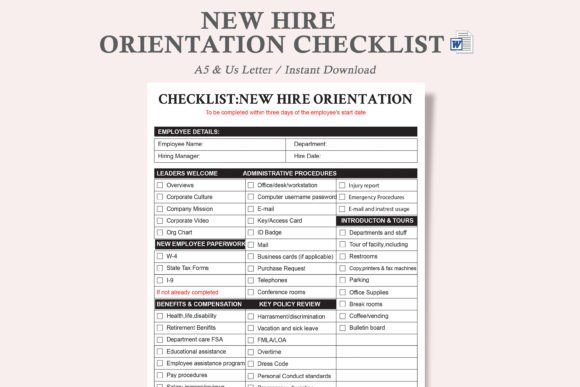
A truly effective checklist covers more than just administrative tasks. It also addresses the human elements that help a new person feel connected and informed. Based on the standard One Page HR Templates and Forms used by many Human Resources professionals, the following categories should be included in any New Hire Employee Orientation Checklist:
Leaders and Organizational Structure
New hires need to know who is who. An orientation should introduce key leaders—both within the immediate team and across the organization. This can include a brief meeting with a department head, a recorded welcome from the CEO, or a simple org chart review. The checklist should prompt the facilitator to confirm that the employee can name their direct supervisor, skip-level manager, and key cross-functional contacts. Understanding leadership structure reduces anxiety and helps the new hire navigate questions more quickly.
Employee Culture and Values
Company culture is not something you can absorb from a handbook alone. A strong orientation checklist carves out time for discussing core values, team norms, communication expectations, and unwritten rules. This might involve a conversation about meeting etiquette, how decisions are made, or how feedback is delivered. Including culture as a distinct checklist item ensures it is not glossed over in favor of paperwork. Many employees leave within the first 90 days because the reality of the culture did not match what they expected. A thorough orientation addresses that gap head-on.
Benefits Enrollment and Employee Leave
Benefits are among the most time-sensitive items in any orientation. New hires often have a limited window to enroll in health insurance, retirement plans, and other voluntary benefits. The checklist should include a step-by-step walkthrough of the benefits portal, explanation of plan options, and clear guidance on employee leave policies—including sick leave, vacation accrual, parental leave, and any state-specific paid leave requirements. This is also the right time to discuss how to request time off and whom to contact with benefits questions. The New Hire Employee Orientation Checklist MS Editable Word template typically includes dedicated checkboxes for each of these items, making it easy to track completion.
Safety Training and Compliance
Safety training is not optional. Whether your workplace is an office, a warehouse, or a hybrid environment, employees need to know emergency procedures, exit routes, fire extinguisher locations, and how to report hazards. The checklist should incorporate both general safety topics (e.g., ergonomics, first aid) and role-specific training. For industries that require OSHA compliance, the checklist serves as a record that mandatory training was delivered. Including safety training as a distinct item protects both the employee and the organization.
Employee Tours and Facility Orientation
A simple tour can make a huge difference in how comfortable a new hire feels. The checklist should prompt someone to show the employee where to find restrooms, break rooms, supply closets, parking areas, and emergency exits. For remote or hybrid workers, the tour might be virtual—covering how to access digital tools, shared drives, and communication channels. Tours are easy to overlook when schedules are tight, but a dedicated checklist item ensures they happen consistently.
Additional Topics That Round Out the Experience
Beyond the core categories, a comprehensive orientation checklist often includes items such as: IT account setup and password management, equipment issuance (laptop, badge, phone), introduction to team workflows and project management tools, review of performance expectations and initial goals, and a clear explanation of the probationary period or check-in cadence. Many HR professionals also include a checkpoint for the employee to ask any lingering questions—something that gives the new hire agency in their own onboarding.
Choosing the Right Format for Your Orientation Checklist
Different teams work differently. A startup might prefer a simple digital checklist that lives in a shared drive, while a larger organization may need a printable form that managers can carry during an in-person orientation. The New Hire Employee Orientation Checklist MS Editable Word template offers flexibility: you can edit the document on your computer, print as many copies as needed, and customize it each time you onboard someone new. The same template often comes in multiple sizes—A5 and US Letter—so you can choose between a compact card or a full-page document. For those who prefer a digital workflow, an editable PDF version allows you to fill in fields without printing. Having both print and digital options means the checklist can adapt to your team’s preferred style rather than forcing a one-size-fits-all approach.
When evaluating a One Page HR Template, look for a design that is professional, minimalist, and ink-friendly. A clean layout reduces visual clutter and makes it easy for busy managers to scan the list quickly. The best templates also leave room for notes or comments, so facilitators can document any follow-up actions or exceptions. Whether you choose a printed copy or a digital version, the key is that the checklist becomes a living tool—used, updated, and referenced—rather than a static document that sits in a folder.
How to Build Your Orientation Program Around the Checklist
If your organization has not yet started a new hire orientation program, the checklist serves as both a guide and a starting point. You do not need to design an elaborate curriculum from scratch. Instead, use the topics in the New Hire Employee Orientation Checklist as a syllabus. Review each item and decide who is responsible for delivering that content, how much time it requires, and whether it should be delivered individually or in a group setting. For many small businesses, the checklist itself becomes the orientation program—each item is a mini-segment that takes five to fifteen minutes to cover.
For example, the "Benefits" item might involve sitting down with the employee to log into the benefits portal together, while the "Leaders" item might be a quick hallway introduction or a scheduled 10-minute chat. By breaking orientation into discrete, checklist-sized pieces, you reduce cognitive overload for the new hire and make the process manageable for the facilitator. Over time, as you see which items generate the most questions or confusion, you can expand those topics into more detailed training modules.
Adapting the Checklist for Different Roles and Contexts
Not every new hire needs the exact same orientation. A remote contractor, a part-time retail associate, and a full-time executive all require different emphasis. The beauty of an editable template is that you can adjust it quickly. A New Hire Employee Orientation Checklist MS Editable Word template allows you to remove items that are not relevant for a particular role (such as a facility tour for a fully remote employee) and add role-specific content (such as software training or client introductions). You can also reorder items to match the sequence of the first day, week, or month.
Consider creating a baseline checklist that applies to all hires and then a supplementary checklist for specific departments or employment types. For instance, safety training might be identical across the company, but benefits explanations could differ between full-time and part-time staff. Keeping the core orientation checklist consistent ensures that no one misses fundamental information, while allowing flexibility for nuance and specialization.
Practical Tips for Using Your Orientation Checklist Effectively
A checklist is only as good as the habit of using it. Train managers and HR coordinators to reference the checklist before, during, and after each orientation session. Before the new hire arrives, review the list to confirm that all necessary materials—such as handbooks, login credentials, and equipment—are ready. During the orientation, check off items in real time rather than trying to recall them later. Afterward, store the completed checklist in the employee’s file as a record of what was covered.
It can also be helpful to give a copy of the checklist to the new hire themselves. This transparency allows them to see the agenda and know what to expect, reducing uncertainty and giving them a sense of progress as items are completed. When the employee can see that benefits, safety training, and culture have all been addressed, they feel more confident that their orientation was thorough.
Finally, revisit your checklist periodically. As your company grows or introduces new policies, the orientation checklist should evolve. Scheduling a quarterly review of the checklist with your HR team ensures that it stays current and continues to reflect the most important topics for new hires. A checklist that gathers dust is a missed opportunity; a checklist that is regularly updated becomes a cornerstone of a great employee experience.
No matter where you are in building your onboarding process, a structured New Hire Employee Orientation Checklist provides the clarity and consistency that new employees need to hit the ground running. By covering leaders, culture, benefits, leave, safety training, tours, and beyond, you create an orientation that is both comprehensive and welcoming. Whether you choose a printed PDF, an editable Word template, or a digital form, the checklist is your most reliable tool for turning a potentially chaotic first day into a confident, positive start.