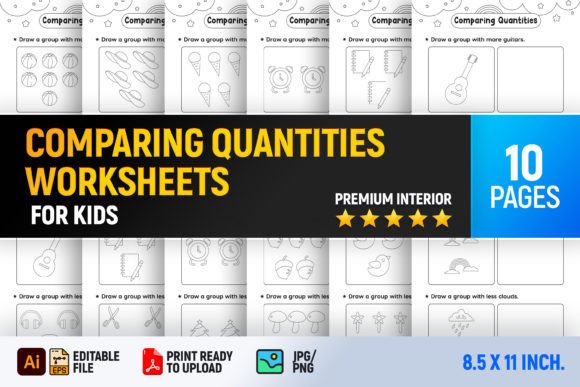
Comparing Quantities Worksheets-Vol 2: A Practical Resource for Early Math Skills
If you’ve ever tried to teach a three- or four-year-old the concept of “more” versus “less” or “bigger” versus “smaller,” you know it can feel like trying to explain the weather to a puppy. Young children learn best through hands-on, visual, and playful experiences. That’s exactly where Comparing Quantities Worksheets-Vol 2 comes in. Designed for children ages 3 to 5, this set of 10 activity pages combines coloring, problem-solving, and foundational math practice in a way that feels like pure fun. But beyond the crayons and smiley faces, these worksheets are a thoughtfully crafted tool for parents, teachers, and caregivers who want to give their little ones a strong start in mathematical thinking.
In this article, we’ll explore what Comparing Quantities Worksheets-Vol 2 offers, the common challenges it helps solve, and practical ways you can use it at home or in the classroom. Whether you’re a homeschooling parent, a preschool teacher, or just someone looking for a constructive rainy-day activity, you’ll find actionable ideas and honest considerations here.
Why Comparing Quantities Matters at Ages 3–5
Before diving into the worksheets, it helps to understand why comparing quantities is such a critical skill for young children. This concept forms the foundation for number sense, measurement, and even early algebraic thinking. When a child can tell you that a pile of blocks has “more” than another pile, or that a tall glass holds “more water” than a short one, they’re not just describing the world—they’re learning to quantify and compare. These skills also support language development (words like “greater,” “fewer,” “equal”) and logical reasoning.
Yet teaching this concept isn’t always straightforward. Many parents struggle to find activities that keep a child’s attention for more than a few minutes. Others worry that worksheets feel too “school-like” for a playful preschooler. Comparing Quantities Worksheets-Vol 2 addresses this head-on by blending creative coloring with structured math tasks. The result is a resource that respects a child’s need for movement and imagination while still delivering serious learning outcomes.
What Makes Comparing Quantities Worksheets-Vol 2 Different?
You’ll find plenty of printable math worksheets online, but not all are created equal. Here’s what sets this set apart from a generic stack of papers.
- Creative coloring on every page. Each worksheet includes handcrafted illustrations that children can personalize. Coloring not only makes the activity more engaging but also strengthens fine motor skills—a bonus for pre-writing development.
- Brain-boosting puzzles. The activities are not just about circling the bigger group; they include mazes, matching, and simple problem-solving that prompt children to think critically. For example, one page might ask a child to color the jar with more candies, then draw a line to the number that matches.
- Educational alignment. While the pages feel like play, they are intentionally designed to reinforce concepts often found in early math curricula and workbooks. This makes the worksheets a perfect supplement for a preschool math book or a structured at-home program.
- 10 unique pages. Each sheet is different, reducing the chance of repetition fatigue. You can use one per day or spread them out over several weeks.
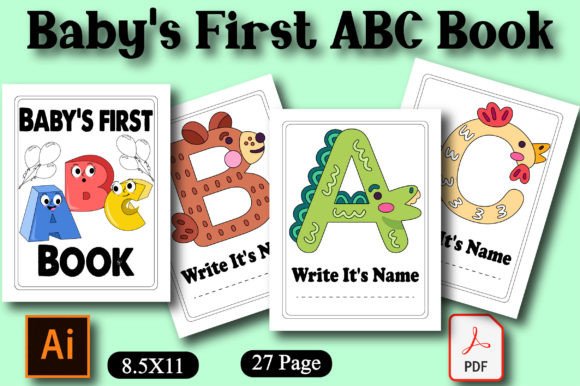
- Digital formats included. You receive an AI editable file (allowing you to customize or adapt), a standard PDF for easy printing, and a JPG version. This flexibility is helpful for teachers who want to project a page on a smartboard or for parents who prefer to print individual pages as needed.
- Instant download & unlimited printing. Once you purchase, you can print as many copies as you like. That means you can use the same worksheet for multiple children, or reprint a page if a child wants to “do it again.”
Challenge 1: Keeping a short attention span engaged
Three- and four-year-olds have famously short attention spans—about five to ten minutes for a seated activity. Comparing Quantities Worksheets-Vol 2 is designed with that in mind. Each page can be completed in a single sitting, and the coloring element gives children a reason to linger a little longer. You might start by asking, “Can you find the group with more apples? Great! Now let’s color that page.” The combination of problem-solving and art keeps even wiggly kids interested.
Challenge 2: Making math feel like a chore
Some children resist any activity that feels like “school.” The colorful, fun illustrations on these worksheets (think friendly animals, candy jars, and playful scenes) shift the focus from “learning” to “playing.” Parents often report that children ask to do these worksheets again—a sure sign that the math content is being absorbed naturally.
Challenge 3: Lack of time for lesson planning
Whether you’re a teacher juggling 20 kids or a parent managing a busy household, preparation time matters. These worksheets require zero setup. Download, print, and hand them over. There are no complicated instructions to follow. The PDF and JPG files are ready to use in seconds. This low-prep nature is a huge win for anyone who wants quality math practice without spending hours cutting and laminating (though you can laminate if you wish).
Challenge 4: Differentiation in mixed-age groups
In a classroom or family setting, children develop at different paces. Some may already understand “more and less” while others are still learning. The worksheets are designed with gradual complexity. Early pages focus on obvious visual comparisons (a group of 3 vs. 10), while later pages may ask children to compare sets that are closer in size, requiring careful counting. You can easily choose which pages to give to which child based on their current level.
Practical Applications: Where and How to Use These Worksheets
The beauty of Comparing Quantities Worksheets-Vol 2 is its versatility. Here are several ways different users can put it to work.
For homeschool families
If you’re homeschooling a preschooler, you likely want a mix of structured and unstructured learning. These worksheets fit nicely into a morning basket or a math station. You might pair a worksheet with physical objects: for example, after completing a page about “more cookies,” give your child a handful of pretend cookies (or crackers) so they can compare quantities in real life. The worksheets become a bridge between abstract symbols and hands-on experience.
For preschool teachers
Classroom teachers can use these pages in small-group rotations, as a take-home packet, or for table-top morning work. Because the file is editable in AI, you can personalize pages with your students’ names or tweak the content to match your current theme (e.g., “comparing acorns” in autumn). The JPG version can be inserted into Seesaw or Google Slides for digital learning if needed.
For caregivers and grandparents
Not every caretaker feels confident teaching math. These worksheets remove the pressure—they come with clear, visual cues that children can often follow independently. You can sit alongside a child, talk through the comparisons, and watch their understanding grow. It’s also a wonderful activity for a rainy afternoon or a quiet time before naptime.
For on-the-go entertainment
Download the PDF onto a device and print a few pages before a road trip or a doctor’s appointment. A clipboard and a pack of crayons turn a waiting room into a mini math classroom. Because the worksheets are instantly downloadable, you can always have a fresh set ready.
Recommendations for Best Results
To get the most out of Comparing Quantities Worksheets-Vol 2, consider these tips:
- Print on quality paper. Thicker paper or cardstock holds up better to enthusiastic coloring and erasing if children use pencils first.
- Use manipulatives alongside. Have counters, buttons, or small toys ready. When a worksheet asks “which row has more?” let the child place a button on each item to make the comparison concrete.
- Encourage verbalization. Ask open-ended questions: “How do you know this group has fewer?” “Can you tell me which one is bigger?” This builds mathematical language.
- Repetition is okay. Children often want to redo a favorite page. That’s fine—repetition reinforces the concept. Print extra copies when you purchase.
- Adapt for different skill levels. If a child finds a page too easy, challenge them to count the exact number in each group. If it seems too hard, cover part of the page and focus on one comparison at a time.
Thoughtful Considerations
No resource is perfect for every situation. While Comparing Quantities Worksheets-Vol 2 excels in many areas, it’s helpful to know where it fits best.
- Screen-free learning. These are printable worksheets, so they require paper and printer ink. If you are trying to minimize printing, you could load the JPG into a drawing app on a tablet and let children complete them digitally. However, the physical activity of coloring and writing offers fine motor benefits that screens cannot fully replace.
- Not a full curriculum. Think of this as a supplement—10 targeted pages that reinforce comparing quantities. They are ideal for practice, review, or enrichment, but you will likely want to pair them with other math games and real-world experiences.
- Age range. The set is designed for ages 3–5. Some advanced 3-year-olds may still need guidance, while some 5-year-olds may breeze through them. Use the AI editable file to adjust the difficulty if needed.
Real-World Outcome: What Success Looks Like
Imagine a child sitting at the kitchen table, tongue slightly out in concentration, coloring a row of five balloons next to a row of two balloons. You ask, “Which row has more balloons?” They point confidently to the row of five. Then they count, “One, two, three, four, five—that’s more!” This is the moment when comparing quantities stops being a worksheet task and becomes a real understanding. The child can later spot that their sibling has more crackers on their plate and articulate that inequality without tears. That’s the transferable skill these worksheets help build.
Over a few weeks of using Comparing Quantities Worksheets-Vol 2, you’ll likely notice children beginning to use comparison words spontaneously. They might comment that a tower of blocks is “taller than” another, or that they have “fewer” grapes than a friend. These are signs that the learning is sticking—and that math is becoming part of their everyday language.
Final Thoughts
Teaching young children to compare quantities doesn’t have to be a struggle. With the right tools, it can be a joyful exploration of numbers, colors, and early logic. Comparing Quantities Worksheets-Vol 2 offers a ready-to-use, flexible, and engaging way to support that exploration. Whether you’re a parent carving out learning time at home, a teacher managing a busy preschool classroom, or a caregiver looking for a meaningful quiet-time activity, these worksheets deliver value without the prep stress.
The instant download means you can start today—and the reprintable pages ensure the fun and learning can continue as long as your child wants to compare, count, and color. Give your little mathematician the gift of playful practice, and watch their confidence grow with every page.