Blank Comic Book Template Graphic Novel: A Practical Resource for Storytelling and Design
For educators, content creators, publishers, and anyone who works with visual storytelling, the right tools can significantly reduce friction in the creative process. Blank Comic Book Template Graphic Novel offers a structured yet flexible framework for building comic strips, storyboards, and panel-based narratives. This collection of 30 different templates, packaged with speech bubbles, multiple file formats, and KDP-ready formatting, is designed to serve both professional and educational workflows. Below is a practical assessment of its characteristics, real-world applications, and overall value.
What Makes Blank Comic Book Template Graphic Novel Worth Discussing
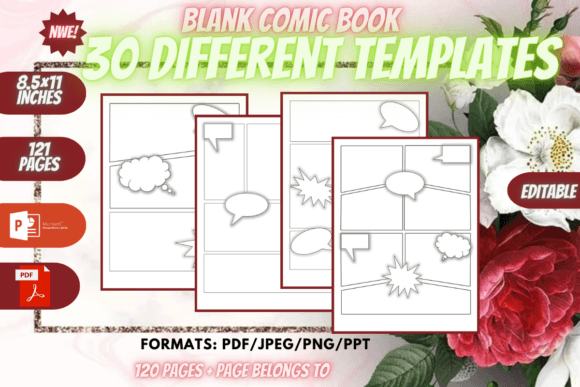
At its core, this product provides a systematic approach to comic creation without requiring users to start from a blank canvas. Instead of drawing panel borders, measuring page layouts, or designing consistent spacing, users can focus on the narrative and visual content itself. The inclusion of 30 distinct templates means that a single purchase covers a wide range of layout possibilities, from simple three-panel strips to more complex multi-panel pages. This variety matters because different stories demand different pacing and visual rhythm. A quick dialogue-heavy scene benefits from fewer, larger panels, while an action sequence may require rapid cuts across many small frames. Having a library of templates on hand eliminates the need to rebuild these structures repeatedly.
The product also addresses practical production needs. The package includes high-resolution JPEG and PDF files, along with PNG and PPT versions, making it usable across different software environments. Speech bubbles are already embedded, which saves time for users who might otherwise spend hours placing and aligning dialogue containers. For anyone who has ever attempted to produce a comic or storyboard from scratch, the time saved by using pre-built templates is immediately apparent.
Key Characteristics and Contents
The template set contains several components worth noting. First, the 30 templates themselves are the primary offering. They range from standard comic strip grids to more elaborate graphic novel page layouts. Each template is provided in PDF and JPEG formats, with additional PNG and PPT versions included for users who prefer to work in presentation software or need transparent background options. The speech bubbles are integrated into the templates, but their placement and sizing leave room for customization if desired.
The product also includes 120 pages of blank comic sheet content in an open-source JPEG and PNG format, along with a belongs page for attribution. The PDF file is formatted to 8.5 × 11 inches, a standard US letter size that prints cleanly and uploads reliably to print-on-demand platforms. Crucially, 100 pages have been formatted and tested for KDP (Kindle Direct Publishing), meaning users who intend to publish their work through Amazon’s platform can use these files with minimal additional setup. All digital files are delivered in a single zip folder, which keeps the download organized.
The inclusion of multiple file formats is a practical strength. PDF files preserve the layout exactly as designed, making them ideal for printing or final submission. JPEG files work well for quick previews, social media sharing, or integration into other documents. PNG files with transparent backgrounds allow users to layer templates over illustrations or photos. PPT files enable direct editing in presentation software, which is useful for classroom settings or collaborative projects where team members may not have access to advanced design tools.
Practical Applications Across Different Fields
Educators are among the primary beneficiaries of this resource. Teachers at the elementary through high school levels can use these templates to create assignments that require students to demonstrate understanding through sequential art. A history teacher might ask students to illustrate a timeline of events. A language arts teacher could use comic strips to teach narrative structure, dialogue, and pacing. The templates remove the obstacle of drawing panel borders, allowing students to focus on content. For educators who work with students with limited drawing confidence, the structured layout provides a supportive framework.
Freelancers and independent publishers also find value here. A freelance illustrator or graphic novelist working on a pitch can use the templates to produce sample pages quickly. Rather than spending hours on layout for a submission package, the creator can concentrate on character design and storytelling. Similarly, self-publishers preparing a book for KDP can take advantage of the pre-tested formatting. The 100 KDP-ready pages reduce the risk of upload errors, margin issues, or bleed problems that often arise when formatting books independently. For someone publishing their first comic or graphic novel, this feature alone can save significant frustration.
Marketers and small business owners use comic-style content for social media posts, email newsletters, and instructional materials. A simple three-panel comic can explain a product feature, illustrate a customer journey, or announce a promotion in a memorable way. The templates provide a consistent, professional-looking structure that maintains brand identity while adding visual interest. Since the files are editable in common software like PowerPoint or any image editor, non-designers can produce usable content without hiring a graphic designer.
Bloggers and content creators who produce tutorials, step-by-step guides, or visual explanations can also benefit. Instead of relying solely on screenshots or text descriptions, a comic strip format can make instructions more engaging. The speech bubbles allow for concise captions, and the panel structure naturally guides the reader from the first step to the last.
Quality, Usability, and Flexibility Considerations
The quality of any template set ultimately comes down to how well it functions in real use. The PDF files here are clean and print at a crisp 300 DPI, which is the standard for professional printing. The JPEG files maintain good resolution as well, though users should check that image quality holds up when scaling for specific projects. The 8.5 × 11 inch size is practical because it fits standard binders, printers, and KDP trim sizes without requiring custom adjustment.
Usability is strong for the core audience. The templates are straightforward: open a file, add your artwork and text, and export. There is no learning curve beyond basic familiarity with the file format you choose. For educators, this means minimal class time spent on technical instructions. For publishers, it means faster turnaround from concept to print-ready file. The speech bubbles are already placed, which is helpful for users who may not know best practices for bubble positioning or sizing.
However, flexibility has some limits worth noting. Because the templates are pre-designed, users who need highly unconventional layouts—such as circular panels, irregular page breaks, or experimental grid arrangements—may find the selection restrictive. The 30 templates cover a broad range of standard layouts, but they do not include every possible variation. For most classroom, marketing, and standard publishing projects, this is not a problem. But for avant-garde or highly stylized work, a custom layout approach might be necessary.
Another consideration is that the speech bubbles are embedded rather than provided as separate overlay elements. This means users who want to move a bubble to a different position or change its shape will need to do so in an image editor. For users comfortable with Photoshop, GIMP, or similar software, this is a minor adjustment. For users who strictly work in PowerPoint or simpler tools, repositioning may be more limited.
Who Benefits Most and In What Situations
The ideal user of Blank Comic Book Template Graphic Novel is someone who needs to produce comic-style content regularly but values efficiency over complete creative control over layout. This includes:
- Teachers who create assignments for multiple classes and need reproducible, consistent templates week after week.
- Self-publishers preparing their first or second graphic novel who want to avoid formatting pitfalls.
- Freelance illustrators who need to produce sample pages quickly for client pitches.
- Small business owners and marketers who produce social media content in batches and want a recognizable visual format.
- Hobbyists exploring comic creation without committing to advanced design software or custom layout tools.
The product is less suited for professional comic artists who require total control over every aspect of page design, or for users who need templates in non-standard sizes or orientations. It is also not the best fit for digital-only projects that require interactive elements, as the templates are designed for static print or image output.
Real-World Performance and Practical Limitations
In practice, this template set performs reliably for the scenarios it targets. Teachers report that students can focus on storytelling and drawing after a quick demonstration of how to use the template. Self-publishers appreciate the KDP-tested formatting, which reduces the number of upload rejections and formatting corrections. Marketers find the templates useful for creating consistent branded content, especially when combined with a corporate color palette and logo placement.
One limitation that emerges over time is related to file management. Because the product includes 120 pages plus multiple format versions, the zip folder is substantial. Organizing the files logically after extraction is essential. Users who keep the folder structure intact will have an easier time locating specific templates later. It is worth spending a few minutes to rename files or arrange them in subfolders based on layout type or format preference.
Another limitation is that the speech bubbles, while convenient, are not editable in terms of shape without external software. Users who want oval bubbles for internal monologue or jagged bubbles for shouting will need to modify the files. This is not a major barrier for most users, but it is worth knowing before purchase if you plan to use multiple bubble styles consistently.
Final Thoughts on Long-Term Value
Blank Comic Book Template Graphic Novel provides a solid foundation for anyone who regularly creates comic-based content. The value lies in the time saved and the consistency achieved across projects. For educators, the templates can be reused semester after semester. For publishers, the KDP-ready files support repeat publishing without reformatting. For freelancers and marketers, the variety of layouts ensures that projects do not all look identical, which keeps visual content fresh.
The product does not promise to turn someone into a professional graphic novelist overnight, nor does it claim to replace advanced design software. What it offers is a practical shortcut from concept to finished page, with enough flexibility to serve a wide range of users. The 30 templates cover most standard needs, and the additional pages and format options extend its usefulness beyond simple comic strips into more substantial projects. If your work involves visual storytelling in any capacity, and you prefer to spend your creative energy on narrative and art rather than page layout, this template set is worth considering as a reliable addition to your resource library.