Minimalist Business Planners Templates: A Strategic Tool for Clarity and Growth
Running a business—whether a solo venture, a creative side hustle, or a growing team—comes with a constant stream of decisions. You juggle tasks, track finances, plan content, and try to keep sight of your long-term goals. For many entrepreneurs and creators, the chaos of daily operations can overshadow the strategic thinking that actually drives progress. This is where a well-designed planning system becomes more than just a to-do list: it becomes a framework for intentional action. A set of minimalist business planners templates offers exactly that—a clean, adaptable structure for organizing your work without the visual noise that often clutters traditional planners.
When those templates are also CANVA editable business planner templates, you gain the ability to tailor every page to your specific brand, workflow, and audience. This combination of minimalism and editability makes such a bundle uniquely useful for two distinct purposes: running your own operations more effectively, and creating a valuable asset for your audience as a lead magnet or product.
Why a Minimalist Approach to Business Planning Matters
Minimalism in design is not about removing everything—it is about keeping only what serves a function. In the context of a business planner, that means reducing visual clutter so your attention stays on the information that matters. Many planners overwhelm you with decorative elements, intricate layouts, and too many fields. A minimalist template, by contrast, gives you white space, clear typography, and simple grids. This is not an aesthetic preference; it is a strategic decision. When you open a page to plan your week or review your sales, your brain should immediately focus on the data, not the design.
For someone launching a printable planner side hustle, this design philosophy also makes commercial sense. Minimalist templates appeal to a broad audience because they are versatile. A customer who runs a coaching practice and a customer who sells handmade goods both need to track goals, expenses, and tasks—but their branding and style differ. By offering minimalist business planners templates that work across niches, you position yourself as a provider of tools, not just decorations.
The Strategic Value of Editability in Canva
The decision to use CANVA editable business planner templates is about empowerment. Not everyone knows how to use professional design software like Adobe Photoshop or Illustrator. Canva’s desktop tool, however, is accessible to a wide range of users—entrepreneurs, marketers, educators, and hobbyists—who can drag and drop elements, change colors, and swap fonts without learning a complex interface. By providing a template that works exclusively in Canva (note: due to file size constraints, it will not function in the mobile app or other software), you remove the technical barrier while preserving design integrity.
From a practical standpoint, editability allows your customers—or your own team—to adapt a single template set to multiple contexts. You might use the same monthly planner layout for January through December, but update the color scheme to match a seasonal promotion. You might use the social media planner this month for Instagram and next month for LinkedIn. The ability to customize without starting from scratch saves time and ensures consistency across every touchpoint.
What the Bundle Includes and How Each Page Serves a Purpose
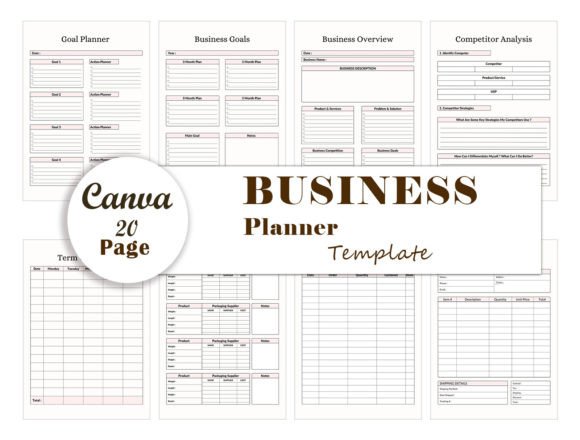
A comprehensive bundle of 20 templates, available in both A4 and Letter sizes, covers the essential functions of a business operation. Let’s walk through the specific pages and examine what they offer from a strategic standpoint, not just a functional one.
Time-Based Planners: Daily, Weekly, and Monthly
These three templates form the backbone of operational planning. The daily planner is for the tactical level—tasks, appointments, and immediate priorities. The weekly planner shifts the view to medium-term goals: which projects advance this week, which client deadlines approach, and what needs preparation. The monthly planner is for review and foresight: revenue targets, content themes, and resource allocation. Using all three together creates a cadence of planning that prevents both micromanagement and strategic drift.
Goal and Review Tools: Goal Planner, Business Goals, Term Overview
Goal setting is often treated as a one-time event, but real progress comes from regular alignment. The goal planner helps you define specific objectives, while the business goals page allows you to track progress across multiple initiatives. The term overview (quarterly or half-yearly) connects your daily actions to your long-term vision. Without these pages, you risk working hard on tasks that do not move the needle.
Financial and Order Tracking: Saving Tracker, Order Tracker, Monthly Sales Tracker, Monthly Profit Tracker
Cash flow is the lifeline of any business. A saving tracker helps you set aside funds for taxes, reinvestment, or slow seasons. The order tracker and monthly sales tracker give you visibility into revenue patterns. Equally important, the monthly profit tracker forces you to account for costs—not just revenue. Many small business owners celebrate sales while ignoring expenses, which leads to distorted decision-making. These templates encourage a more honest financial picture.
Customer and Market Analysis: Target Customer Market, Competitor Analysis
Understanding your audience and competition is not a one-time research project; it is an ongoing practice. The target customer market template lets you define and refine your ideal customer profile. The competitor analysis page provides a structured format for comparing offerings, pricing, positioning, and messaging. Using these regularly helps you spot shifts in the market before they become crises.
Product and Packaging Planning: Product Planner, Packaging Planner
For businesses that sell physical or digital products, these templates support the development process. The product planner helps you map out features, timelines, and launch steps. The packaging planner addresses presentation—label design, materials, sizing, and branding consistency. These pages are often overlooked in generic business planners, yet they directly affect customer perception and unboxing experience.
Shipping, Returns, and Supplier Management: Shipping Tracker, Return Tracker, Supplier List, Order Form
Operational efficiency depends on smooth logistics. The shipping tracker and return tracker help you monitor fulfillment and handle customer issues promptly. The supplier list centralizes contact information, pricing, lead times, and reliability notes. The order form can be used internally or shared with clients for custom orders. Together, these templates reduce the friction that often slows down smaller operations.
Content and Social Media: Social Media Planner
For creators and marketers, content planning is a core business function. The social media planner template lets you schedule posts, track themes, and review performance across platforms. When aligned with your monthly goals and product launches, it turns content from a random activity into a coordinated strategy.
Using the Bundle for Your Own Business: A Strategic Workflow
Downloading a set of templates is only the first step. The real value emerges when you integrate them into a repeatable planning routine. Consider the following workflow as a starting point:
- Monthly review: Start each month by opening your monthly planner, business goals, and monthly profit tracker. Review what worked last month, what did not, and set three priorities for the coming weeks.
- Weekly alignment: Each week, use the weekly planner to break those monthly priorities into specific actions. Check your order tracker and shipping tracker to ensure fulfillment is on schedule.
- Daily execution: Use the daily planner to list your most important tasks. Limit yourself to three to five items to maintain focus.
- Quarterly deep dive: Every quarter, open the term overview, target customer market, and competitor analysis pages. This is your time to evaluate positioning, adjust pricing, or refine your product lineup.
- Content rhythm: Use the social media planner to map out posts in alignment with product launches, seasonal trends, or business milestones.
This workflow prevents the templates from becoming static documents. They become a living system that evolves with your business.
Using the Bundle as a Lead Magnet or Side Hustle Product
If you are looking to grow your email list or generate revenue through a printable planner side hustle, this bundle offers two distinct paths. First, as a lead magnet, you can offer the minimalist business planners templates as a free download in exchange for an email address. The high perceived value of 20 editable pages makes it an attractive offer for entrepreneurs, freelancers, and small business owners who are actively seeking better organization tools.
Second, you can sell the templates as a product. Because they are editable in Canva, you can customize the colors, fonts, and branding to match your own style before selling them—or offer them as-is with a clean, universally appealing design. The key is to communicate the specific problems each page solves. Instead of simply listing “daily planner,” explain how it helps a busy professional reduce overwhelm by prioritizing tasks. Instead of “competitor analysis,” describe it as a tool for identifying gaps in the market.
When positioning this bundle, consider the following strategic observations:
- Specificity sells: Your audience is not looking for “a planner.” They are looking for a solution to scattered tasks, missed deadlines, or unclear goals. Address those pain points directly.
- Editability is the differentiator: Many static planners exist. The fact that this bundle is editable in Canva means your customer can make it their own. That is a powerful advantage.
- Niche targeting works: While the templates are designed for general business use, you can market them to specific groups—solopreneurs, Etsy sellers, coaches, consultants—by showing how each page applies to their unique workflows.
Risks of Using Templates Without Clear Goals
No tool is a substitute for strategy. The most significant risk of using any planner bundle is treating it as a checklist rather than a thinking tool. Filling out a monthly sales tracker without analyzing trends or adjusting your approach yields little benefit. Completing a competitor analysis without acting on the insights is an exercise in busywork.
To avoid this pitfall, approach each template with a question. Before you open the goal planner, ask: “What do I want to achieve this month that would make a meaningful difference?” Before you use the product planner, ask: “What does my customer actually need that I am not currently providing?” The template is a framework for answering these questions—not a substitute for asking them.
Another risk is over-customization. When you have editability, it is tempting to spend hours adjusting colors, fonts, and layouts instead of using the planner for its intended purpose. Set a time limit for customization, then start planning. The design’s job is to support your work, not become your work.
Long-Term Value: Building a Planning Habit That Endures
The ultimate value of any planner is not found in the first week or even the first month. It is found in the habit of returning to the system and refining it over time. A bundle of 20 templates gives you enough variety to address different aspects of your business, but the real growth comes from consistency. Use the templates long enough, and you will start to notice patterns in your own behavior—which tasks you avoid, which goals you delay, which months produce the most revenue. That awareness is the foundation for better decisions.
For those building a side hustle around printable planners, this long-term perspective also applies to your product strategy. The bundle you offer today can be the first in a series. Listen to what your customers say about the templates. Which pages do they use most? What other tools do they request? Use that feedback to develop additional products, such as industry-specific planners, extended goal-setting workbooks, or complementary budgeting templates.
Final Considerations Before You Start
Before you download and customize the bundle, take a few minutes to clarify your purpose. Are you using it primarily for your own business operations? If so, identify which three pages will address your most urgent pain points—and start there. Are you using it to grow your email list? If so, plan how you will introduce the templates to your audience, what value you will highlight, and how you will follow up with subscribers after they receive the download.
Because the templates work only in the Canva desktop tool, ensure you and your audience have access to a computer for editing. This is not a limitation if you plan accordingly, but it is an important detail to communicate clearly. The templates will not open in other software or on the Canva mobile app, so set expectations upfront to avoid confusion.
Finally, treat the bundle as a starting point, not a final solution. Your business evolves, your goals shift, and your audience grows. The best planning system is one that adapts with you. A set of minimalist business planners templates that you can edit and revisit gives you that flexibility—without the overhead of designing from scratch.