KDP Pattern Coloring Book Canva Template: Streamlining Geometric Art Publishing
The intersection of algorithmic art and accessible self-publishing continues to carve out strong niches within the digital marketplace. Geometric pattern coloring books, in particular, have sustained a loyal following among adults seeking mindful relaxation and educators looking for structured artistic activities. Yet, the gap between having a viable concept for a coloring book and holding a publishable, print-ready asset is often filled with technical hurdles, expensive software, and hundreds of hours of manual drafting. The KDP Pattern Coloring Book Canva Template directly addresses this gap, providing a structural backbone for creators who want to prioritize publishing strategy and market reach over repetitive graphic design work.
Anatomy of a Premium KDP Asset: 50 Unique Geometric Patterns
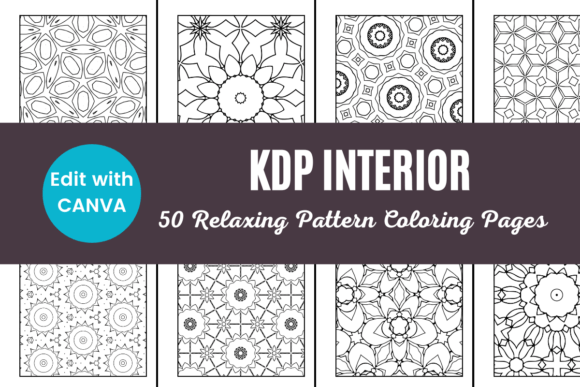
A successful coloring book relies heavily on the quality, variety, and technical execution of its internal pages. The KDP Pattern Coloring Book Canva Template provides a collection of 50 unique geometric pattern coloring pages. These are not random stock fillers; they are constructed to deliver a cohesive aesthetic while offering diverse levels of complexity. This structural variety allows a single book to cater to colorists with different skill levels, from those who prefer broad, simple shapes to those who crave intricate, micro-detail line work.
- Design Cohesion: Repeating geometric motifs tie the book together visually, making it read like a curated gallery rather than a disjointed set of images. This is critical for Amazon's "Look Inside" feature, where consistency sells the product.
- Print Readiness: Every page is formatted to 8.5 x 11 inches, the standard trim size for trade paperback coloring books on KDP. This eliminates guesswork during the upload process.
- Resolution Integrity: Built at 300 DPI, the line art remains crisp and sharp. High resolution ensures that the intricate geometric lines avoid pixelation, which can occur with lower resolution assets or improperly exported files.
For creators, this composition eliminates the most time-consuming phase of production: the content creation bottleneck. Instead of spending weeks drafting 50 distinct patterns from a blank canvas, one can pivot directly to customizing the existing framework, adjusting page sequencing, or bundling the book with supplementary products.
The Psychological Appeal of Geometric Symmetry
The enduring popularity of geometric coloring pages is not accidental. Mental health professionals and art therapists frequently utilize mandalas and geometric patterns to help clients achieve a state of calm focus, often referred to as the "flow state." The repetitive nature of coloring within defined, symmetrical lines can lower cortisol levels and provide a structured break from overstimulation. By utilizing the KDP Pattern Coloring Book Canva Template, a content creator, educator, or wellness advocate is not merely selling a book; they are providing a structured tool for cognitive relaxation.
The patterns within this template are specifically designed to facilitate this experience. They offer intricate spaces that reward careful attention without causing visual fatigue. The balance between complexity and open space is a deliberate characteristic that aligns with the therapeutic coloring trend, making the asset highly relevant to the current wellness market. A researcher studying the effects of coloring on fine motor skills in elderly populations, for example, could deploy these standardized geometric designs to ensure uniformity across a study group.
Workflow Integration: Utilizing the Canva Editable Template Link
The "Canva Editable Template Link" is the key differentiator of this asset. In the past, a digital template purchase meant a static, unchangeable PDF. If a creator wanted to adjust a line weight, translate a title, or rebrand the book for a different niche client, they needed expensive desktop publishing software like Adobe InDesign or Illustrator. The Canva ecosystem has fundamentally democratized this process, placing powerful editing tools into a browser interface.
Customization Possibilities Available Through the Link:
- Branding: Educators or business owners can add a school logo, a website URL, or a personalized message to the introductory page.
- Rebranding Assets: A savvy entrepreneur can easily change the cover text and title page to rebrand the same internal content for different niches, such as "Calm Geometry for Adults" versus "Cool Shapes for Teens."
- Sampling for Marketing: Creators can export high-quality JPEGs or PNGs of specific pages directly from Canva to use as sample images for Amazon listings, Etsy previews, or social media marketing campaigns.
- Color Proofing: While the line art is designed for coloring, the ability to add a single background color or tint in Canva allows for unique versioning, such as a "golden ratio" themed book with subtle background washes.
This asynchronous workflow means the template serves as a master file. Once a creator makes a change to the Canva master, they can re-export the entire PDF in minutes, reducing the risk of errors during bulk publishing and ensuring that every version is up to date.
Bridging the Gap Between Digital Design and Print Formatting
One of the primary considerations for any KDP author is the setup of bleeds, margins, and trim lines. An 8.5 x 11 inch book requires specific internal margins to ensure that content is not cut off during the binding and trimming process. Amazon's print preview tool is notoriously strict; a single stray line or missing margin can cause a rejection. The KDP Pattern Coloring Book Canva Template comes pre-calibrated with these technical specifications already applied.
This eliminates the common frustration of designing a beautiful coloring page, only to have it fail the KDP print preview because of margin errors or insufficient resolution. The 300 DPI standard ensures that the lines hold up in a large print run and look professional on high-quality paper. For a creator, this peace of mind is invaluable. It allows them to focus on marketing and distribution, confident that the technical foundation of the product will pass review.
Comparative Analysis: Template vs. Traditional Creation Methods
To fully understand the value proposition, it is worth evaluating the template approach against the traditional path of publishing a coloring book.
- Traditional Hand-Drawn Artwork: This path requires significant raw artistic talent, scanning equipment, and cleanup work in Photoshop or GIMP. Creating 50 unique patterns takes hundreds of hours. The cost of materials and time is extremely high, and replication is difficult without professional digitization.
- Commissioned Illustration: Hiring a professional illustrator to create 50 unique geometric patterns can cost thousands of dollars. While you generally retain full commercial copyright, the upfront investment is prohibitive for many small businesses and individual creators.
- Using the KDP Pattern Coloring Book Canva Template: This approach provides a high-quality, consistent foundation instantaneously. The creator retains full editing ability. The time investment shifts from creation to customization and marketing, taking only a few hours to produce a finished book. The cost is a fraction of a commission.
Considerations for the Professional User: Using a template naturally means the core vector shapes are not entirely "original" to you in the sense that another buyer could craft a similar book. However, because the template is fully editable in Canva, significant differentiation is possible through branding, cover design, page ordering, and the addition of bonus content like test pages or color guides. The ethical use of templates is well established within the KDP ecosystem, provided the user adheres to the specific End User License Agreement (EULA). Typically, a commercial license is included, permitting the sale of the completed book on Amazon, while prohibiting the resale of the unaltered template itself.
Identifying the Practical Applications for Different Users
The flexibility of the KDP Pattern Coloring Book Canva Template makes it a viable asset for a surprisingly broad audience, each with distinct goals and workflows. This cross-functional utility is a testament to the maturation of the print-on-demand template industry.
The Small Business Owner and Content Creator
For those running an Etsy shop or a Gumroad store, this template provides a rapid method for inventory expansion. A digital download business relies on volume and variety. Having a ready-to-publish 50-page coloring book allows the business to offer a high-value product without months of lead time. The content creator can use the Canva link to generate a series of themed books, ensuring brand consistency across their catalog while significantly increasing the perceived value of their storefront.
The Educator and Art Therapist
Teachers in art or mathematics classrooms can use geometric coloring pages to intuitively teach concepts of symmetry, tessellation, and color theory. The KDP Pattern Coloring Book Canva Template can be used to print individual pages for a specific lesson or compiled into a semester-long workbook. Art therapists can leverage the standardized designs to track a patient's progress or to provide a non-threatening entry point into creative expression. The clean, controlled output of the exported PDFs ensures a professional presentation in any academic or clinical setting.
The Hobbyist and Personal Development Advocate
Individuals seeking a screen-free hobby can purchase the template for personal use. They gain the ability to print pages as many times as they wish, trying different color combinations on the same pattern without committing to a physical book. The 8.5 x 11 inch size is large enough to be engaging and satisfying but small enough to be portable and easy to store.
Technical Precision: Understanding 300 DPI and 8.5 x 11 Inches
Technical specifications often separate a professional product from an amateur one. Let's break down the two most critical specifications embedded in this template. 300 DPI, or Dots Per Inch, is the industry standard for commercial offset and print-on-demand printing. An image at 300 DPI designed at 8.5 x 11 inches contains roughly 2550 x 3300 pixels. This pixel density ensures that the lines of the geometric patterns appear smooth and continuous, rather than jagged or blurry. When a customer examines the line art through a magnifying glass or scans the page, the detail holds up perfectly.
The 8.5 x 11 inch format is chosen for its practical balance. It is large enough to contain complex, satisfying patterns without feeling cramped, yet it is also the standard size for US letter paper. This makes it easy for customers to print at home if they purchase the digital download version. When publishing through KDP, this size fits into the standard distribution model efficiently. It does not incur unusual shipping costs or require special packaging, which keeps the royalty margins healthy for the publisher.
Observing Market Trends and the Future of Template-Assisted Publishing
The creator economy is moving steadily toward asset utilization and strategic curation. The expectation within the self-publishing community is shifting from "I created every pixel from scratch" to "I curated and published a high-quality product that meets a specific market need." The KDP Pattern Coloring Book Canva Template is a perfect representation of this shift. It is a tool that empowers people who have a sharp publishing strategy or a business mindset but lack the advanced graphic design skills or the sustained time required to execute from a blank page.
Geometric patterns are uniquely suited to algorithmic trends. These patterns often perform exceptionally well on visual social media platforms, where short-form videos showing time-lapses of coloring are highly engaging. The bold, clear lines of the templates in this collection make them ideal for such showcase content. Creators can use a printed page from the template to film satisfying "oddly satisfying" videos, driving significant traffic back to their Amazon or Etsy listings.
The future of low-content and medium-content publishing lies in the quality of the structural foundation. By reducing the barrier to entry, these templates allow more diverse voices to enter the market. A therapist can now create a custom workbook for their patients. A math teacher can create a geometry enrichment book for their students. A parent can create a custom quiet-time activity book for their child. The template is the mechanism that makes this rapid, high-quality publishing possible, bridging the gap between professional output and accessible technology.